Rimere, an American cleantech startup founded in 2020, develops an advanced plasma technology that reforms methane, a major component in natural gas, into carbon-negative hydrogen gas and solid carbon (graphene). By decarbonizing the existing natural gas infrastructure, Rimere aims to rapidly achieve a clean hydrogen solution that the world urgently needs.
Challenges: hydrogen fuel
Hydrogen (H₂), the most abundant element in the universe, is not just a fundamental building block of stars—it’s also a vital ingredient in the synthesis of ammonia. Ammonia production is at the heart of creating a plethora of products that we rely on daily, from the fertilizers that nourish our crops to the plastics that are woven into the fabric of modern life.
Traditionally, the world has leaned heavily on steam methane reforming (SMR) to produce over 60 million tons of hydrogen annually. However, this method comes with a significant environmental cost. It’s an energy-intensive process that contributes approximately 2% to the global carbon dioxide (CO₂) emissions, releasing between 5 and 9 tons of CO₂ for every ton of hydrogen it generates.
But there’s a cleaner path forward: water electrolysis. This process splits water into hydrogen and oxygen using electric current and comes in various forms, including alkaline water electrolyzer (AWE), proton exchange membrane water electrolyzer (PEMWE), and solid oxide electrolysis cells (SOEC). When these electrolyzers are powered by renewable energy sources—think nuclear, solar, and wind power—the result is “green hydrogen.”
However, water electrolysis contributes less than 0.1% to global dedicated hydrogen production. This is mainly due to its high cost and high energy requirements, since water hydrolysis requires considerable electricity in order to dissociate water to yield hydrogen and oxygen. The current electrolysis systems need between 53 and 70 kWh of energy for every kilogram of hydrogen they make. Therefore, the cost of electricity for the energy-intensive water electrolysis process is a significant factor in the high production cost of hydrogen generated by such systems.
Rimere Technology
Rimere has developed hybrid plasma technology that converts methane (CH₄) or natural gas into hydrogen gas and carbon (graphene). Hybrid plasma is a combination of microwave plasma generated by a microwave generator and dielectric barrier discharge plasma generated by an induction system. The hybrid plasma efficiently energizes methane and dissociates it into its elemental parts of hydrogen and carbon. Rimere’s reactor uses a sequential hybrid plasma design that efficiently reforms methane into hydrogen gas and graphene.
How Rimere reforms methane to hydrogen and carbon
As depicted in the diagram below, Rimere uses an induction system to generate plasma, such as dielectric barrier discharge (DBD) plasma.

The system has a low-turn primary coil and a high-turn secondary coil, which are placed near each other. They work together to form a step-up transformer. A high-voltage power supply sends electrical current through the primary coil, which in turn induces current in the secondary coil. The secondary coil drives a higher voltage to energize capacitively coupled electrodes, generating plasma.
One of the advantages is that this induction system can provide a very high voltage to the plasma electrodes without transmitting such a high voltage directly to the electrodes through the power line. This avoids power leakage.
Based on this induction system, Rieme has developed a hybrid plasma reactor that converts methane into hydrogen and carbon, as depicted in the diagram below.
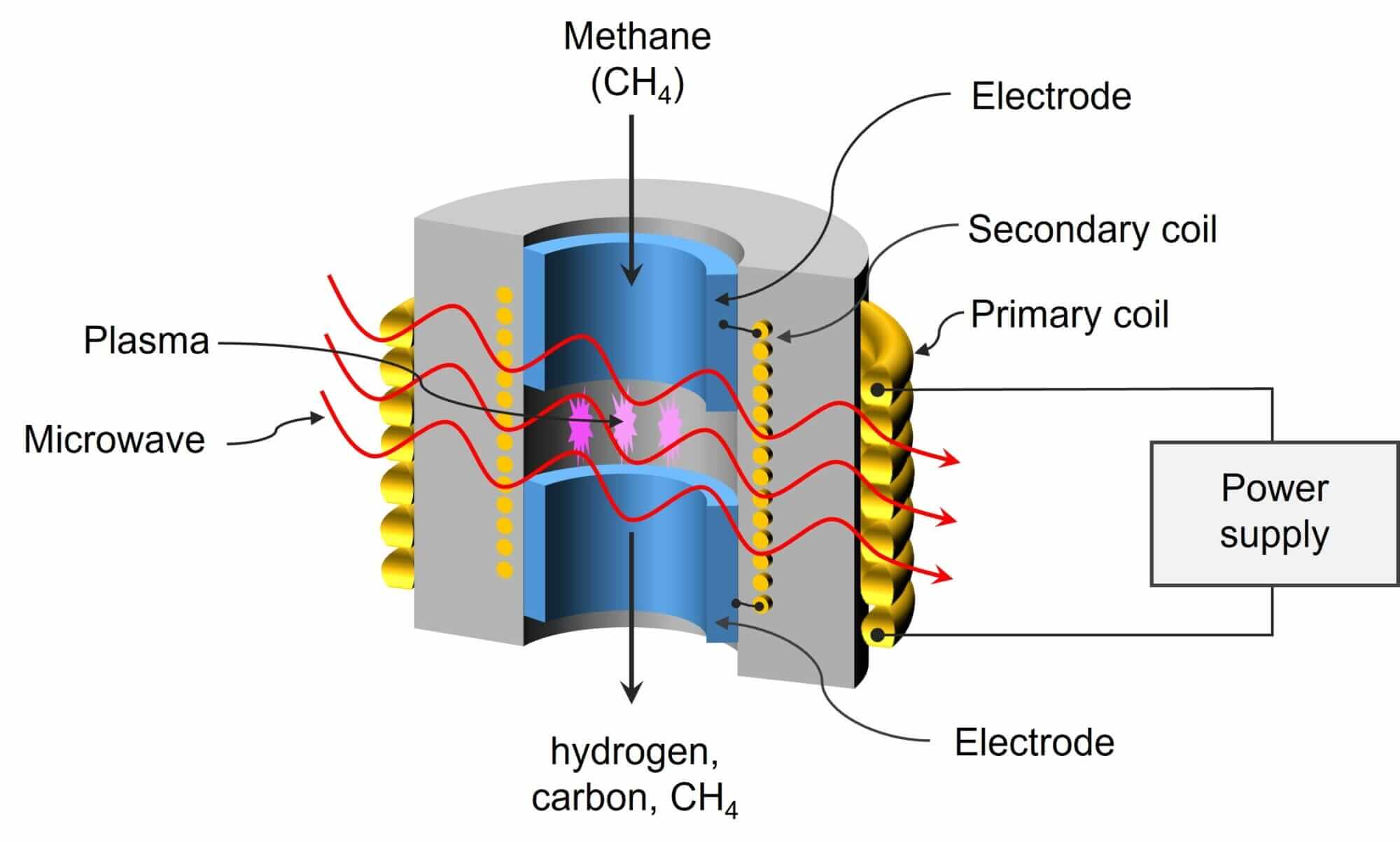
The tube reactor also has a low-turn primary coil and a high-turn secondary coil. The primary coil wraps around the exterior wall of the reactor. It is connected to a high-voltage power supply. The secondary coil wraps around the reaction zone. It is encapsulated in a high dielectric insulating material, such as glass or quartz. The secondary coil is electrically coupled to an electrode assembly within the reactor chamber.
The power supply provides the primary coil with a voltage range of 500 volts (V) to 50,000 V. The secondary coil will be induced to drive a higher voltage, up to 1 megavolt, to the electrodes. The electrodes generate plasma (such as DBD plasma) within the reaction zone to excite methane (or natural gas) that passes through the excitation zone.
A microwave guide drives microwaves toward the plasma to generate a microwave plasma in the reaction zone. A hybrid plasma is formed when plasma and microwave plasma combine. This hybrid plasma energizes the methane, reforming it into carbon and hydrogen gas.
Methane feedstock can pass through a sequential hybrid plasma to increase methane reforming efficiency, as shown in the diagram below.
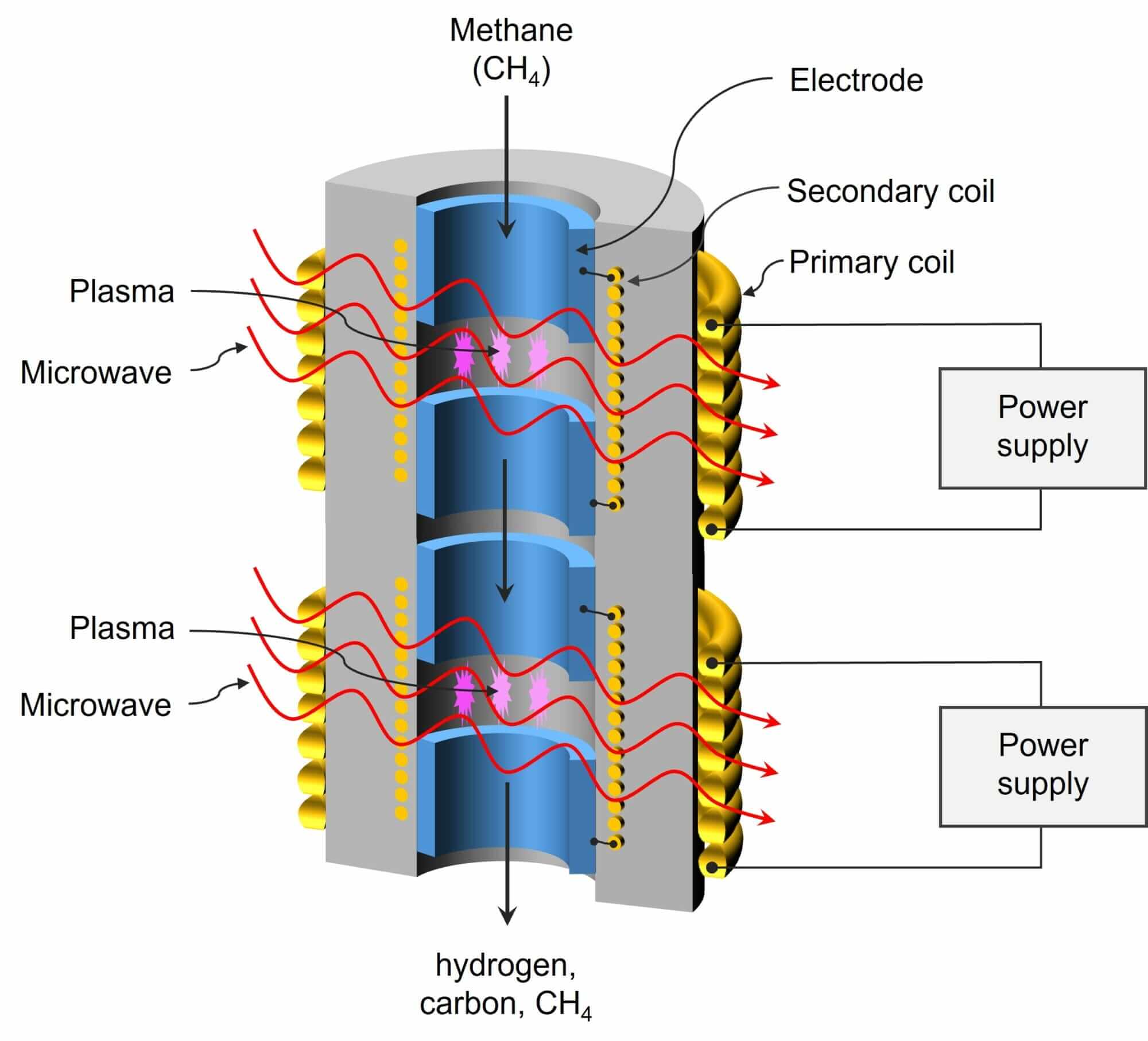
Methane feedstock passes to the first reaction zone, where an inductive coil is used to form an induction plasma. Microwaves are directed at the first reaction zone to form microwave plasma. The hybrid plasma energizes and dissociates methane into hydrogen and carbon.
Unreacted methane and products enter the second reaction zone, where the hybrid plasma further dissociates unreacted methane into hydrogen and carbon.
The product and the remaining methane pass through an outlet of the reactor. Elemental hydrogen recombines to form hydrogen gas in its natural state. Elemental carbon forms carbon solids (graphene). They are further processed, separated, and purified to obtain hydrogen gas and graphene.
Rimere Patent
- US20230225042A1 Systems and methods of plasma generation with microwaves
Rimere Technology Applications
- Clean hydrogen production
Rimere’s hybrid plasma reactors convert methane (the main component of natural gas) into hydrogen and solid carbon. They can be used for point-of-use hydrogen generation for retail hydrogen fueling stations and heavy truck/fleet vehicle refueling, as well as for industrial processes requiring hydrogen as feedstock or fuel.
- Abating methane emissions
Rimere’s technology can reduce the potent greenhouse gas effects of fugitive methane emissions escaping from natural gas infrastructure like pipelines and compressors.
- High-value graphene
Rimere’s reactors can produce high-value graphene without any greenhouse gas emissions. Because of its exceptional properties, graphene has numerous potential applications across various industries.
Graphene’s high electrical conductivity makes it suitable for use in next-generation electronics such as transistors, integrated circuits, and optoelectronic devices.
Graphene can improve energy storage in batteries and supercapacitors. It can enhance solar cell efficiency by increasing light absorption and charge transport. More efficiently, graphene membranes can produce heavy water for nuclear plants. Its thermal conductivity makes it useful for heat dissipation in electronics and LED lighting.
Rimere Products
- The Reformer
The Reformer is Rimere’s flagship product that transforms natural gas (methane) into clean hydrogen and high-quality graphene, without creating any carbon dioxide emissions. Using renewable natural gas (RNG) as the feedstock can produce hydrogen with a negative carbon-intensity rating, significantly reducing emissions compared to even renewable electrolysis methods.
Rimere is currently developing a Reformer unit that can produce between 400 and 600 kg of hydrogen per day.
- The Mitigator
The Mitigator is a plasma thermal oxidizer that reduces the potent greenhouse gas effects of fugitive methane emissions escaping from natural gas infrastructure like pipelines and compressors.
Rimere Funding
Rimere has raised a total of $10M in funding over a Corporate round on Feb 13, 2024.
Rimere Investor
Rimere is funded by Clean Energy Fuels.
Rimere CEO
Brian Harmison is CEO.